Bible, body and corporeality: a status quaestionis... not really!
DOI:
https://doi.org/10.54260/eb.v42i153.1302Keywords:
body, corporeality, person, symbolism, artificial intelligenceAbstract
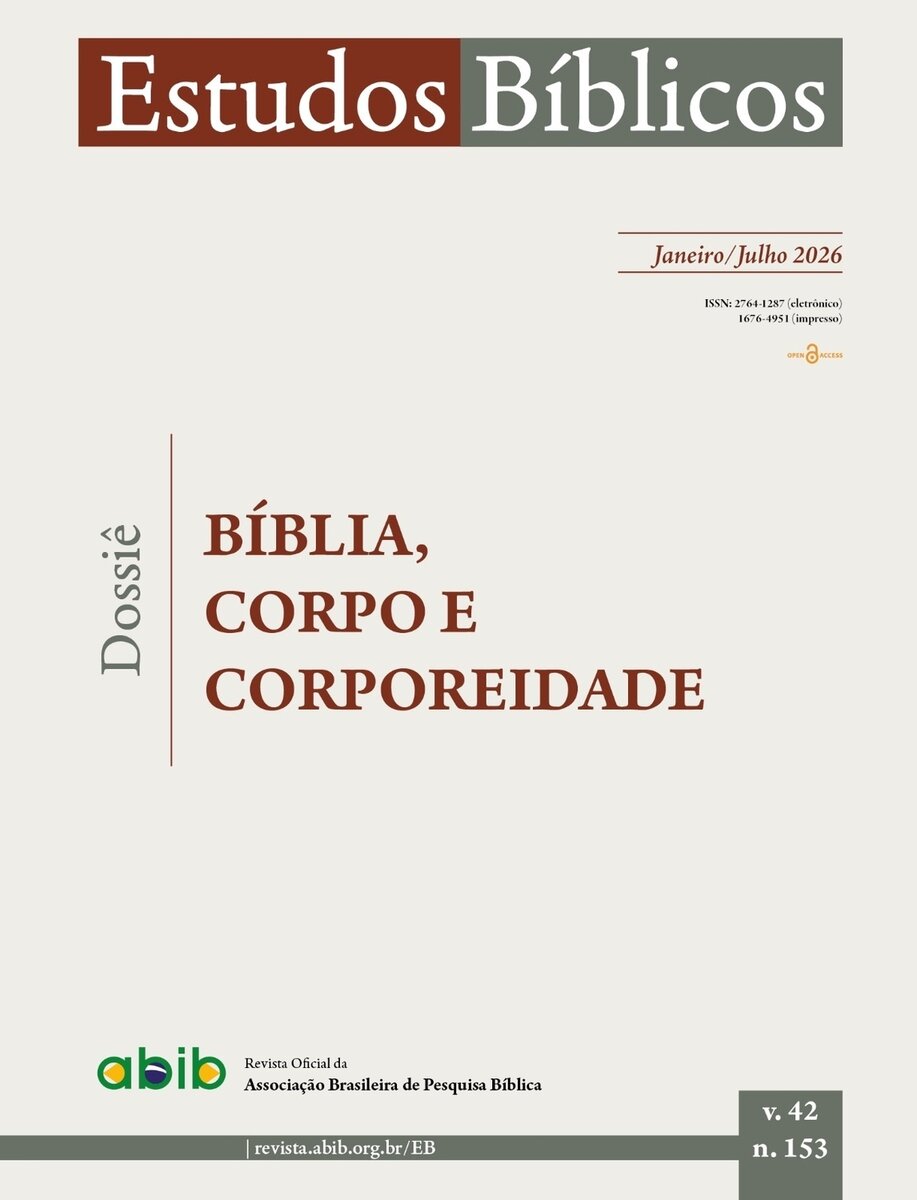
In dictionaries, the word “body” is polysemous: it designates both a physical organism, composed of limbs, tissues, and organs, and a group of people brought together by a common condition or choice, in addition to other derived meanings. This polysemy is also present in the Bible: besides the physical bodies of animals and humans, it also speaks of the body of God and the mystical body of Christ. The human body is much more than matter: it is an essential part of human reality, an expression of the person, a place of encounter with the divine, a space of dignity, and an instrument for happiness. This same human body is used as a symbol and point of reference to imagine the divine body and, through it, to speak of the qualities, defects, and actions of God and other spiritual beings. This article constitutes the opening lecture of the XI International Congress of Biblical Research, organized by Abib – the Brazilian Association of Biblical Research – at PUC-Rio in 2026, under the theme “Bible: body and corporeality.” The author’s choice was not to elaborate a status quaestionis in the classical sense (a systematic and chronological presentation of research and publications on the subject), but rather to present a map composed of the various aspects related to the theme of body and corporeality in the biblical books. For each aspect, a synthesis of the content provided by three artificial intelligence tools is offered.
References
ASSOCIAÇÃO BRASILEIRA DE PESQUISA BÍBLICA. XI Congresso Internacional de Pesquisa Bíblica da Abib – Rio de Janeiro, 2026. Abib, São Paulo, 2 mar. 2026. Disponível em: https://www.abib.org.br/novo/congresso-abib-2026. Acesso em: 15 maio 2026.
CATECISMO da Igreja Católica. A Santa Sé, Cidade do Vaticano, [s. d.]. Disponível em: https://www.vatican.va/archive/cathechism_po/index_new/p1s2cap3_683-1065_po.html. Acesso em: 14 maio. 2026.
CENTRE INFORMATIQUE ET BIBLE (org.). Dicionário enciclopédico da Bíblia. São Paulo: Loyola, 2013.
COSTACURTA, Bruna. La vita minacciata. Roma: PIB, 1988.
FRANCISCO, Edson de Faria. Léxico do Antigo Testamento Interlinear Hebraico-Português. Barueri: SBB, 2024. v. 5.
RÖMER, Thomas C. A origem de Javé. São Paulo: Paulus, 2016.
RONECKER, Jean-Paul. O simbolismo animal. São Paulo: Paulus, 1997.
SCHROER, Silvia; STAUBLI, Thomas. Simbolismo do Corpo na Bíblia. São Paulo: Paulinas, 2003.
STANTON, Elizabeth Cady. A Bíblia para as mulheres. São Leopoldo: CEBI; Anglicana, 2019.
STAVRAKOPOULOU, Francesca. God: An Anatomy. London: Picador, 2021. Disponível em: https://archive.org/details/god-an-anatomy-2021. Acesso em: 16 maio. 2026.
Downloads
Published
Issue
Section
License
Copyright (c) 2026 Cássio Murilo Dias da Silva

This work is licensed under a Creative Commons Attribution 4.0 International License.